Whenever you are around knives or have a chance to handle them, you will almost certainly hear the word “sharpness.”
On social media and television, you see phrases like “the ultimate sharpness” or “a knife with excellent sharpness.”
Of course, it is true that these are the only common ways to express it, so it becomes a matter of how the word is defined. However, in reality, the “sharpness” most people refer to only points to “ease of cutting” or “ease of use” for the user, and in most cases, it is not “sharpness” for the sake of the ingredients.
What we mean by this is that many knives on the market are mostly not the best knives for the ingredients themselves.
This is an area that is still difficult even for Japanese people to understand—a very complex world—but as Japanese people, we would be happy if you could know that “there are people who are pushing the boundaries of this new world.”
Definition of Sharpness
In Japanese, the word for sharpness is KIREAJI. When we look at its components, KIRE means “to cut” and AJI means “taste” or “flavor.” While AJI can also describe the degree or quality of something, the fact that it literally means “flavor” implies that in cooking, the impact on the taste of the food is an essential part of the definition of KIREAJI.
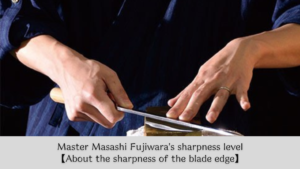
This definition was established by Masashi Fujiwara of Tsukiyama Yoshitaka Hamono, the only researcher in Japan studying how knives change the flavor of ingredients.
In Japan and elsewhere, most people imagine sharpness as simply “how easily or smoothly a knife cuts.” However, a kitchen knife is not just a tool for cutting objects; it is a tool for preparing food for human consumption. In this context, we define “sharpness” as the level at which the cut directly influences the flavor of the ingredients.
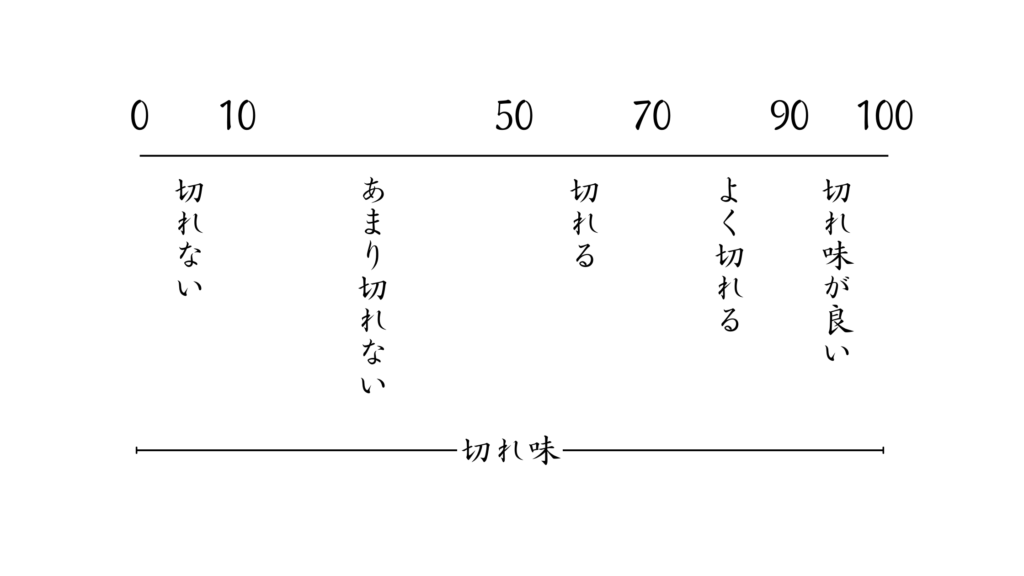
Dull Knife / Slightly Dull Knife : A state where the edge is crushed or rounded, requiring a sawing motion to cut. This includes knives like those found at 100-yen shops that lack a proper edge.
Sharp Knife / Very Sharp Knife : An edge that has been sufficiently sharpened to allow for smooth cutting without resistance, or a state where the knife feels easy to use.
KIREAJI-Sharp Knife (Knife with true Sharpness) : A state that is significantly easier to cut with than a standard “sharp” knife. It minimizes damage to the food’s cellular structure to the absolute limit, bringing out the ingredient’s true potential and creating a positive impact on the flavor.
We define these as the definition of sharpness.
The difference between a knife that is easy to cut with and a knife with good KIREAJI
Since you might find it hard to distinguish between “cutting well” and “good KIREAJI” from what we have discussed so far, we will next consider the difference between an “edge that is easy to cut with” and an “edge that does not destroy the cells of the ingredients.”
First, let’s imagine a jagged blade like a saw and a straight blade.
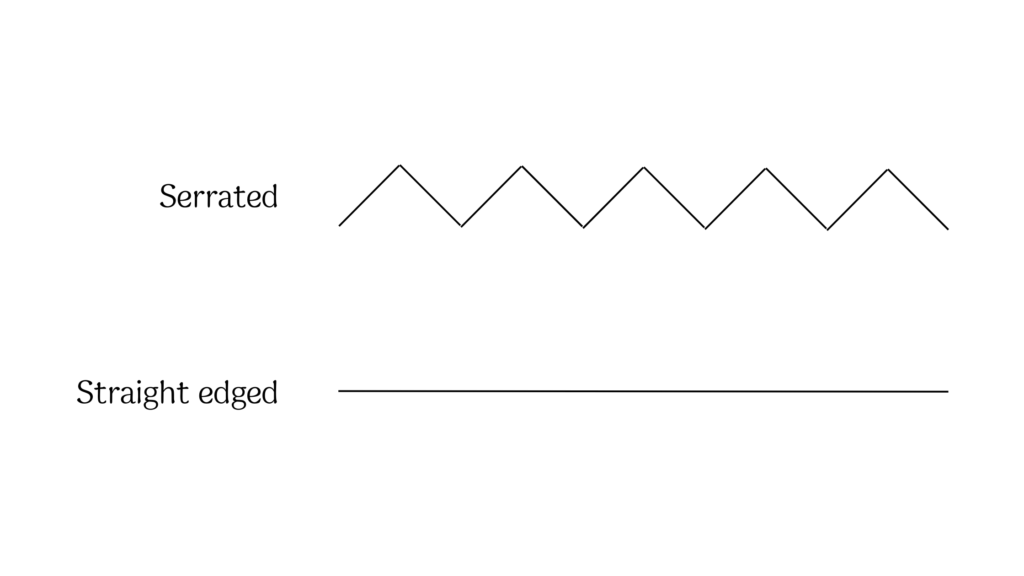
Suppose we use these two types of edges to cut a baguette.
Just imagine: “Which one seems easier to cut with?”
With a baguette, you can probably imagine that the jagged blade would catch better and feel easier to cut with.
Now, what if you were asked, “Which one would create a cleaner cross-section?” The answer would be the straight blade.
If we assume that “cutting cleanly = not destroying cells = the ingredients taste better,” then we can see that this does not necessarily correlate with the user’s “ease of cutting.”
The same thing is happening in the invisible microscopic world.
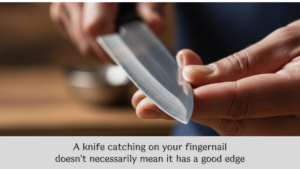
A typical “sharp knife” is actually in a state like a “microscopic saw” that prioritizes the user’s sensation (ease of cutting), and in many cases, it scores only 60 to 70 points in terms of true sharpness (good KIREAJI).
It is often marketed and explained that a state where it is easy and smooth to cut means the KIREAJI is also good and the ingredients are being cut beautifully and deliciously. However, an edge that is easy to cut with and an edge that does not damage the ingredients are completely different.
Of course, when compared to a 10-point knife, a 60-point knife is certainly easier to cut with and provides a plus in terms of sharpness (the flavor of the ingredients).
However, it is slightly different to say that it is the ultimate.
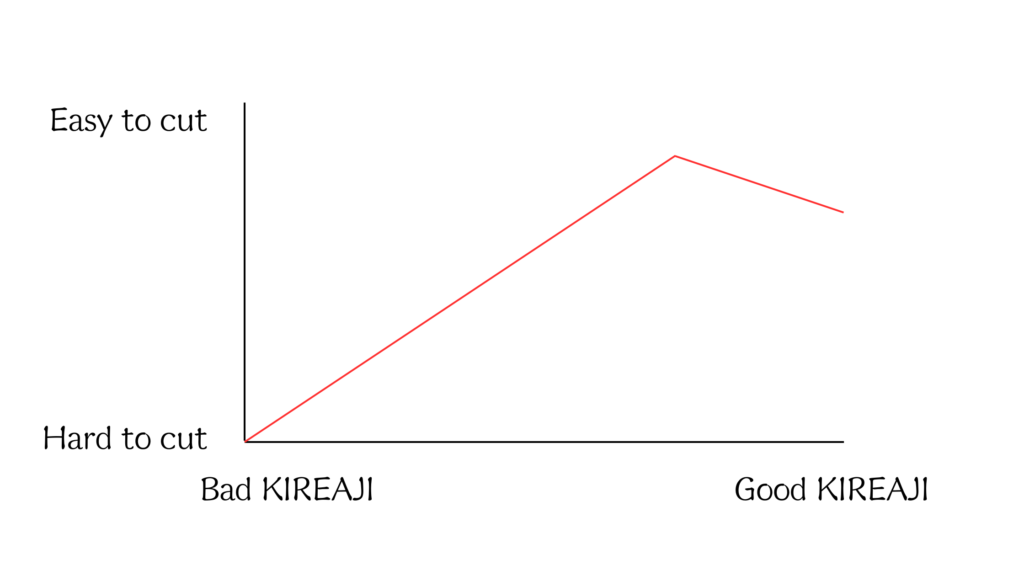
This is what it looks like.
Once sharpness exceeds a certain level, it does not necessarily mean it will be easy for the user to use.
While ease of cutting prioritizes the user’s sensation, KIREAJI is about looking one step ahead, focusing on the customer and the flavor of the dish.
The purpose itself is KIREAJI
We hope you now have a general understanding of the definition of “good KIREAJI.”
In a broad sense, “KIREAJI” means “how to cut while preserving the original flavor of the ingredients.” In other words, how delicate and straight we can make the edge to cut without destroying the cells—that is what true KIREAJI is.
However, based on that, if there is a different purpose such as the intent of the dish or a specific preference, or if we prefer the off-flavors or bitterness over the taste of the ingredient itself, then an edge state that intentionally brings out those off-flavors could also be called a type of KIREAJI.
For example, fresh, freshly caught fish sashimi originally has no fishy smell. To avoid destroying that original flavor, a knife that is thoroughly sharpened is defined as a “knife with good KIREAJI.”
Yet, some people enjoy that “fishiness” as a flavor. In that case, there are people who find it more delicious when cut with a dull knife (by destroying the cells).
Certainly, in daily life, there are few opportunities to eat freshly caught fish, so many people likely believe the taste and aroma that develop after some time has passed is the original flavor of the fish.
In that sense, while we cannot call a dull knife a “knife with good KIREAJI,” it should be acknowledged as one type of “KIREAJI” in terms of the range of expression, rather than being denied.
Of course, knives scoring 60 or 70 points are not bad. There is no problem as long as we communicate according to the purpose, such as “ease of cutting.” However, our point is that it might be slightly incorrect to describe that level as the “pinnacle of KIREAJI.”
We are not rejecting the knives themselves. If there is a “flavor we want to express through cooking,” we want people to know that there is a “higher-level option” that many still do not know about. We feel it is a waste to limit one’s choices by assuming the current state is the pinnacle without knowing the world beyond it.
Particularly in Japanese cuisine, where the flavor of the ingredients is highly valued, the knife is just as important an element as the seasoning.
By the way, the “scent of the shore” or “scent of the sea,” which is often mistaken for the taste of the fish, is caused by a substance called trimethylamine (TMA). Simply put, it is a type of decomposition product. It originally exists in the bodies of saltwater fish as an odorless substance called trimethylamine oxide (TMAO), but once the fish dies and freshness declines, it is broken down by the enzymes of microbes (bacteria) and changes into trimethylamine (TMA), which emits a strong fishy smell.
What is the pinnacle of KIREAJI?
Finally, we will briefly touch on the ultimate KIREAJI for ingredients.
First, an illustration of a “dull knife” versus a “sharp knife.”
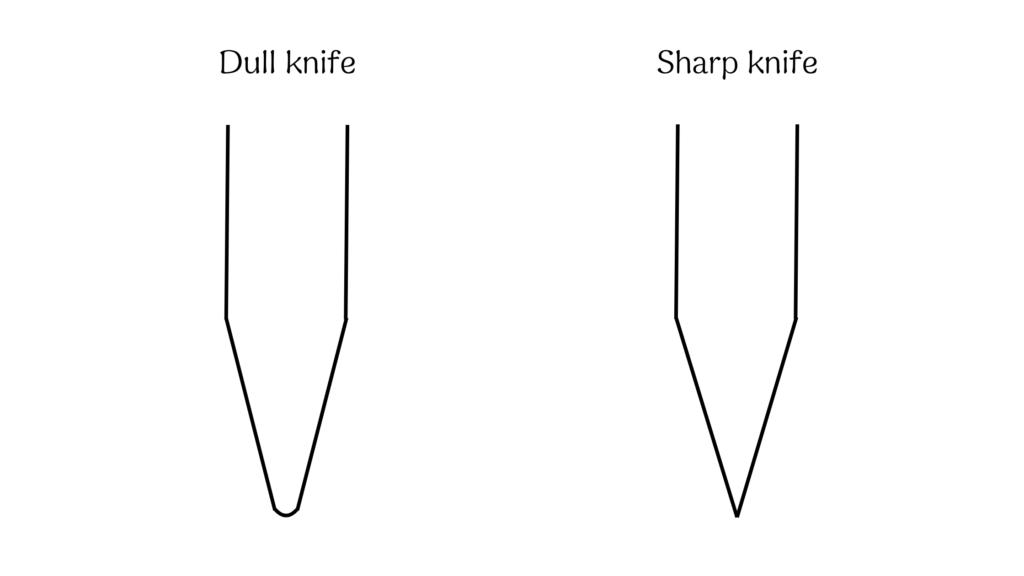
And here are illustrations of a “sharp knife” versus a “knife with good KIREAJI.”
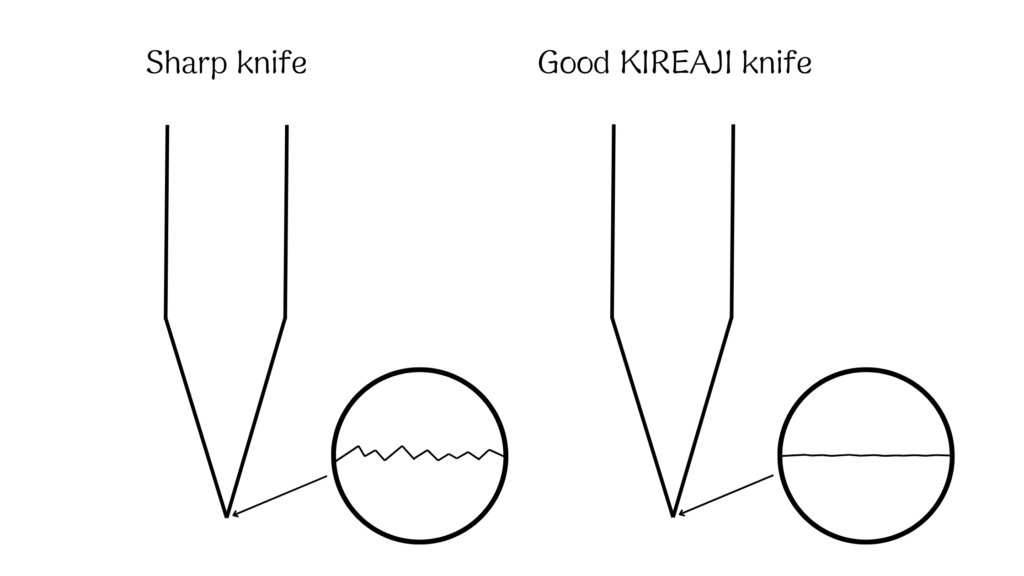
This is just one example, but when viewed under a microscope, this is the difference between a “sharp knife” and a “knife with good KIREAJI.”
The world of the blade edge is a place where a single particle is measured in microns.
When comparing them at that scale, even among Japanese knives generally considered “good,” there is as much difference between one of those and a knife sharpened to near perfection as there is between a “saw and a box cutter.”
With that much of a difference, we believe you can see how it would significantly impact delicate ingredients.
Of course, at the micro-level, it is also true that many people find a slightly serrated edge (one with some coarseness) easier to handle because it bites into the food better. Therefore, a coarser edge can be said to be better suited for work that prioritizes efficiency.
Furthermore, a knife sharpened to the extreme does not only have advantages. Because it is sharpened to the particle level, the edge will naturally chip if struck even slightly too hard, and the duration of that sharpness is not something that can be maintained for regular household use. It is a level of KIREAJI that can only be achieved when the user, the ingredients, and the whetstone all come together in perfect harmony.
In fact, to achieve such a delicate edge, we must choose a knife made from high-quality particles, but that is often difficult with the knives commonly distributed in Japan. Also, there are very few people in Japan, including Masashi Fujiwara, who possess the skill to finish them to this level of perfection.
That is why top-tier Japanese chefs request him to sharpen their knives. While it is not something that can be easily imitated, we would be happy if you knew that there are people doing such incredible, almost unthinkable work.
However, as we mentioned before, KIREAJI at 10 points or 50 points each has its own characteristics and its own merits. Looking at what is commonly available, it is true that as “ease of cutting” increases from 10 to 20 or 30, the ingredients will become proportionally more delicious to a certain extent.
100 points is not everything.
Our point is that by looking at “KIREAJI” from a new perspective, your range of choices may broaden.
If you would like to learn more deeply about the world of “KIREAJI,” it might be interesting to attend a workshop by Master Fujiwara of Tsukiyama Yoshitaka Hamono.
There is a video on YouTube where we talk briefly about the difference between “cutting well” and “good KIREAJI,” so please take a look if you are interested.
If you go directly to YouTube, you can watch it from this point.