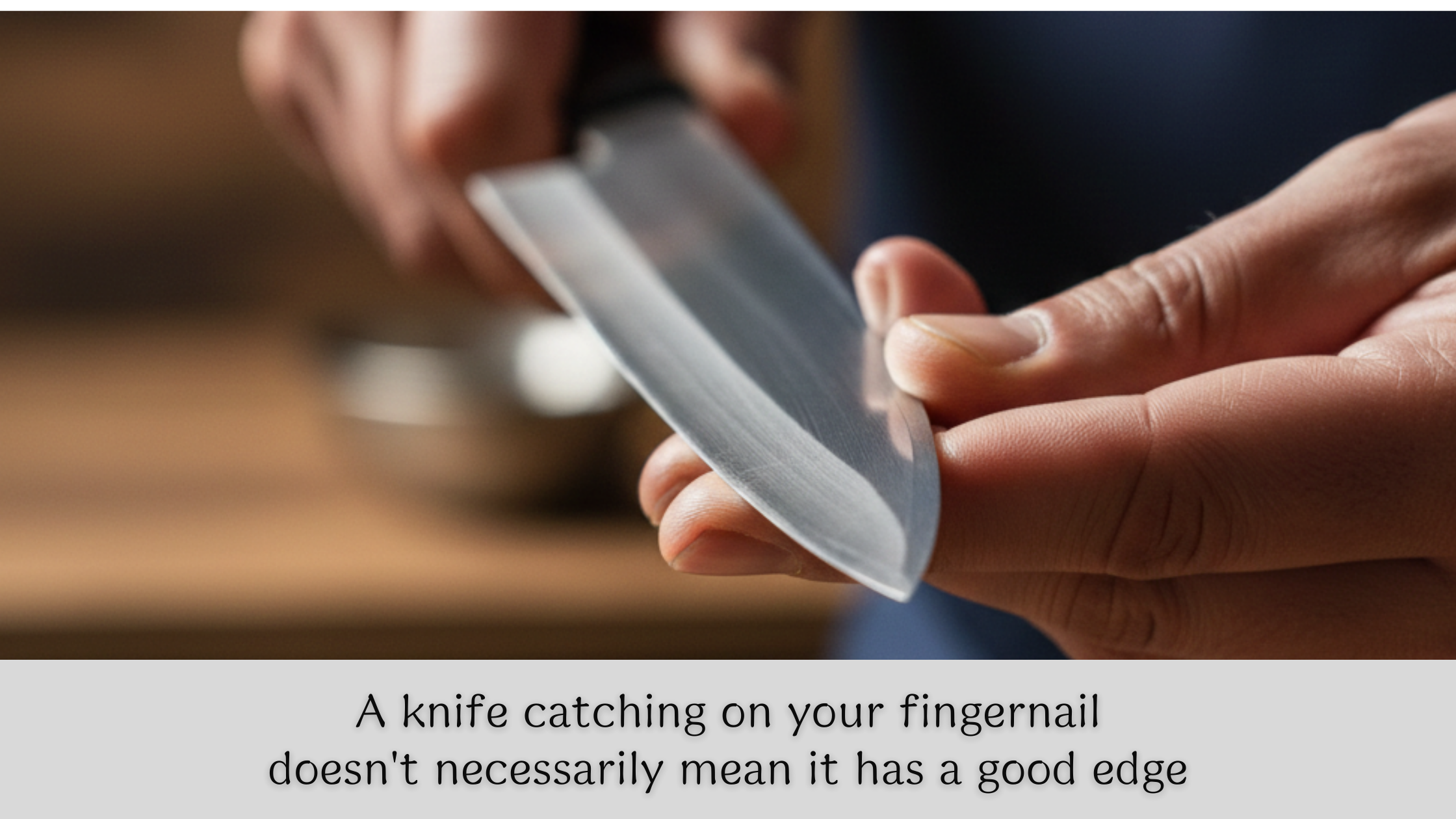
The practice of “checking sharpness by pressing the edge against your fingernail” is taught in many places, including professional kitchens, culinary schools, and on YouTube. Consequently, many people use this method to test their knives.
Of course, as a means of determining the bare minimum of whether a knife “can cut or not,” it isn’t 100% wrong. However, it is often presented as a way to confirm the “ultimate edge,” and in that regard, it is simply not accurate.
This is because an edge that merely catches on the fingernail is nothing more than the starting point when compared to true sharpness. Before we dive into this issue, let’s begin by redefining what the word “sharpness” actually means.
Definition of Sharpness
In Japanese, the word for sharpness is KIREAJI. When we look at its components, KIRE means “to cut” and AJI means “taste” or “flavor.” While AJI can also describe the degree or quality of something, the fact that it literally means “flavor” implies that in cooking, the impact on the taste of the food is an essential part of the definition of KIREAJI.
This definition was established by Masashi Fujiwara of Tsukiyama Yoshitaka Hamono, the only researcher in Japan studying how knives change the flavor of ingredients.
In Japan and elsewhere, most people imagine sharpness as simply “how easily or smoothly a knife cuts.” However, a kitchen knife is not just a tool for cutting objects; it is a tool for preparing food for human consumption. In this context, we define “sharpness” as the level at which the cut directly influences the flavor of the ingredients.
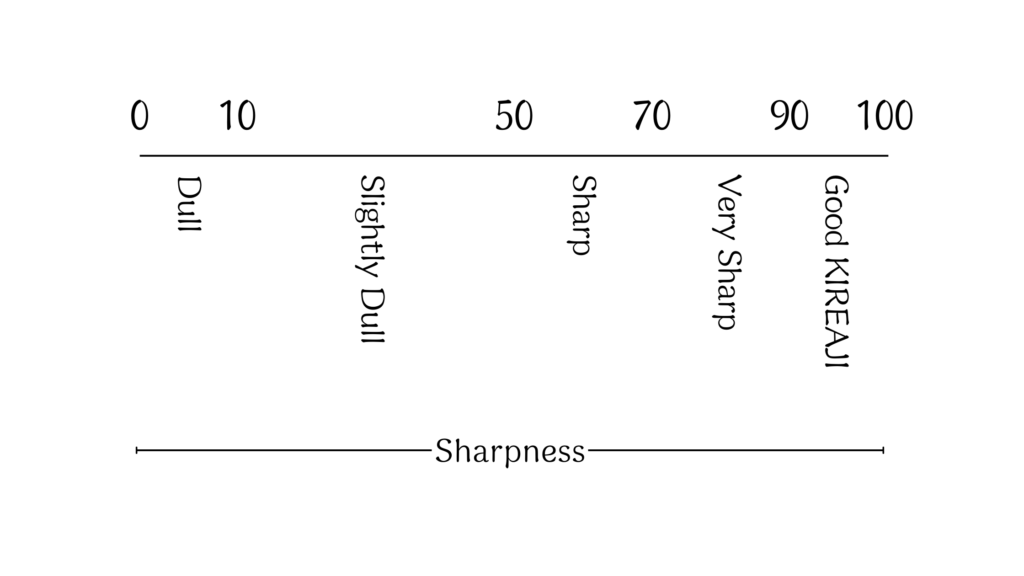
Dull Knife / Slightly Dull Knife : A state where the edge is crushed or rounded, requiring a sawing motion to cut. This includes knives like those found at 100-yen shops that lack a proper edge.
Sharp Knife / Very Sharp Knife : An edge that has been sufficiently sharpened to allow for smooth cutting without resistance, or a state where the knife feels easy to use.
KIREAJI-Sharp Knife (Knife with true Sharpness) : A state that is significantly easier to cut with than a standard “sharp” knife. It minimizes damage to the food’s cellular structure to the absolute limit, bringing out the ingredient’s true potential and creating a positive impact on the flavor.
Please read this article for more details.
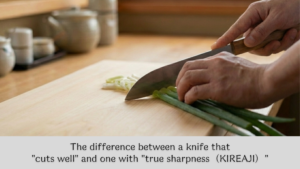
If we define these terms based on “KIREAJI,” the state where the blade catches on your fingernail is not a state of “true sharpness (KIREAJI),” but rather simply a state where it is “easy to cut.”
Catching = Sharpness?
Why is an edge that “catches” on a fingernail often called “sharp”? The reason is simple. In most people’s minds, the following equation has been established:( “Catching” = “Coarse edge” )= “Easy to cut” = “Sharp (KIREAJI).”
However, once you introduce the concept of the ingredient’s “flavor,” you must understand that the equation changes: “Catching” = “Coarse edge” = “Easy to cut” ≠ “Sharp (KIREAJI).”
The reason it catches on your fingernail is that the knife’s edge is coarse
By “coarse,” we do not mean visible nicks or a jagged edge, but rather microscopic roughness within a state that has already been sharpened to a certain degree.
Why does it catch on the fingernail? The reason is that the edge retains a “level of roughness” that allows it to snag on the nail’s fibers. While it is difficult to provide exact figures, it is generally said that a human fingernail is equivalent to a whetstone grit of approximately #2,000 to #3,000.
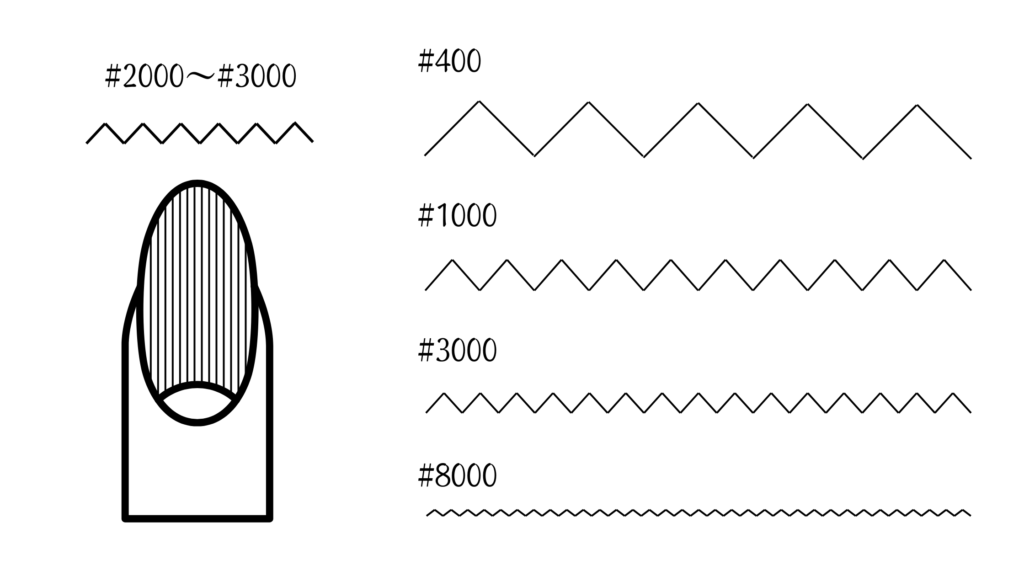
As shown in this diagram, the finer the edge becomes, the less likely it is to catch on the fibers of your fingernail.
Ironically, this means that a “perfectly sharpened knife (a knife with true KIREAJI)” can sometimes be misunderstood as a “dull knife” when using this specific testing method.
Some might argue, “I use a finishing stone to sharpen my knife, but it still catches on my nail!” To be blunt, even if you are using a #10,000 grit stone, the reason it still catches is likely because the edge hasn’t actually been finished to the level that the grit suggests. In other words, there is still room for improvement in the sharpening technique.
We are not saying this to criticize anyone; we simply want people to recognize the fact that “it catches because the edge is still jagged.” When you look at it from the perspective of “cutting cleanly and beautifully to preserve flavor without bitterness,” a state that catches on the fingernail is not necessarily the “state that produces the best-tasting food.”
It would be a great shame to stop at the limited judgment of “it doesn’t catch, so it’s dull,” as you would be missing out on the true depth and potential of a knife’s sharpness.
Being “not sharp” is not necessarily a bad thing
Finally, we do not mean to say that a state of low sharpness (a coarse edge) is necessarily “bad.”
There are certainly drawbacks to an edge that is too fine, and in high-volume professional kitchens, a bit of coarseness can sometimes lead to better work efficiency.
What matters is whether there is a “purpose.” We believe it is necessary to choose and use your tools properly according to your goal.
・For this specific ingredient, this level of coarseness provides the best efficiency.
・For this specific dish, this level of coarseness brings out the flavor I want to express.
Whether it is work efficiency, ease of maintenance, or the flavor of the ingredients—the person serving the food is the one who decides the overall balance. With that in mind, if you judge that “for this menu, an edge that catches on the nail is just right,” then that is one correct answer.
However, letting go of the stereotype that “if it catches on the nail, it is in good condition for everything” will broaden your options. You must choose the state of your knife (its sharpness) based on your purpose, your goal, and the flavor you want to express.
The most important thing is to go as far as actually cutting the ingredients and tasting them for yourself. Ideally, you should think about the current state of your knife by working backward from those results.
Furthermore, the condition of the edge changes significantly not only by the sharpening method but also by the quality and type of whetstone and steel. Learning and deepening your understanding of these factors is essential for a chef and should be a fascinating challenge.
We also have a video on YouTube where we talk about the “fingernail check,” so please take a look if you are interested.
If you go directly to YouTube, you can watch the content starting from this topic.