The other day, we received this interesting comment on YouTube.
Recently, I often see videos on YouTube comparing the sharpness of knives. However, most of them only test the difference between stainless steel and carbon steel, or how the grit of the whetstone changes the flavor.
In reality, I believe the flavor also changes depending on the type and condition of the ingredients, as well as the cooking method. I wonder how much reproducibility these results actually have when only superficial conditions are imitated without aligning these underlying premises.
If the outcome changes significantly depending on the combination of conditions, I feel that unless the exact conditions of the comparison are clearly stated, the conclusion reached is merely a temporary answer for that specific moment.
While I find it entertaining, I have some doubts about making definitive claims, such as “this steel is better,” based on those results alone.
Lastly, using fish as an example, I am interested to know which step—from harvesting and processing to the moment it is eaten—has the greatest impact on flavor, and how much the finer details actually influence the final taste. I would appreciate it if you could let me know. 🙇♂️
It is true that we see many videos comparing sharpness lately.
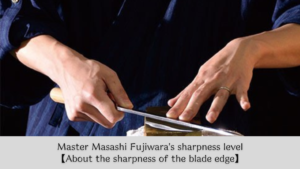
Of course, when it comes to sharpness, Mr. Fujiwara is a pioneer who has scientifically analyzed the “change in flavor caused by sharpness” and proven it through numerical data, and he continues his research every day.
Recently, with the influence of “NOMI RESTAURANT,” which has an extraordinary obsession with sharpness, we feel that the concept of sharpness is becoming more widespread in the world.
In this context, while we have the impression that many people are starting to take an interest in the “difference in flavor brought by sharpness,” we also feel a trend in content creation where people think “videos about sharpness or cutting comparisons will simply get views.” This gives us the impression that the topic is being consumed somewhat carelessly.
There are so many knife experiment videos on YouTube
Many knife experiment videos on YouTube, such as comparisons between carbon steel and stainless steel or taste differences based on natural whetstones, have a fundamental issue: the lack of standardized preconditions.
While these videos often focus on the specific steel or whetstone type, they frequently ignore or fail to disclose other critical variables like the type of fish, the knife’s geometry, and the specific sharpening technique.
If these other conditions significantly alter the outcome, the experiment only proves the superficial result that “the knife changed the taste,” rather than providing a meaningful conclusion like “this specific steel produces this specific taste.” For example, if Whetstone A improves the flavor of Fish A but weakens the flavor of Fish B, claiming “Whetstone A makes sashimi taste better” based only on Fish A is factually incomplete and technically incorrect.
Furthermore, even with identical materials, differences in manufacturing and finishing play a huge role. Factors like how the fish was caught, slaughtered, and processed have a much larger impact than most people realize. When these variables interact—sometimes multiplying the effect and other times canceling it out—the overall direction of the result can change entirely.
Ultimately, without controlling these variables, most experiment videos remain mere entertainment rather than actual scientific experiments.
The Challenges and Doubts of Experiments
When we think of an “experiment,” it seems easy enough to grab a knife and some ingredients from the supermarket. But even if you notice a difference, there are simply too many variables to reach a definitive answer.
Take someone like Mr. Fujiwara, for example. We believe his experiments work because every other condition is meticulously controlled—essentially at a “100-point” level of perfection. Only then can he truly verify how much the blade itself changes the outcome. He isn’t just talking about broad categories like Shirogami or Aogami; he is looking at differences under far more minute conditions.
Specific answers to how a blade affects food can only be found when all other variables are strictly fixed. If a video explained these preconditions before showing the results, it would be incredibly meaningful. However, making a definitive claim like “this steel tastes better” based on a half-baked experiment feels irresponsible.
It is too easy for someone to say, “Knife A makes the flavor richer,” just because they want to sell Knife A. People without specialized knowledge will take that as the absolute truth. That is why it is essential to distinguish between mere entertainment and the truths that hold up in a professional environment. We must look closely at what lies behind the information presented.